The home of Bob Hope. Designed by John Lautner. 23,000 square feet. One-of-a-kind. All of this adds up to one hell of a home, and one that is now on the market for 50 million dollars. Quite a spot, and one that harkens back to the glory days of old Hollywood, in classic over-the-top fashion. Via FastCo Design:
National Geographic’s December issue is about the world’s biggest trees, and their team of photographers and explorers climbed many of the world’s largest trees to take size surveys, etc. Here they are in Sequoia National Park climbing “The President”, a 3200 year old ‘beaut that is most likely the largest tree in the world, by mass. To think that a living thing that has been around since well before the Romans and since early Egyptian days is, frankly, staggering.
An interesting and sad look at artificial zoo habitats, which attempt a realistic environment for visitors, but leave much to be desired for the animal in captivity.
Zoos are inherently bizarre. The sheer thrill of seeing strange and exotic beasts is often tempered by the reality of the strange and artificial environments they’re kept in, raising the question: Can they really be happy hanging out in those habitats? Photographer Daniel Kukla makes a point of visiting zoos as often as possible on his travels, documenting his findings in Captive Landscapes.
“I believe that zoos have the ability to function as incredible research and educational institutions, but more often than not, the animals are put on as a spectacle and the educational aspect seems to be lacking. I always leave feeling a mix of awe and depression from these places,” he tells Co.Design. His series spans these “theatrical environments” in 12 locales across America and Europe, most of which he shot through a window or door from the same vantage point viewers would get when they visit.
Perhaps the most fascinating aspect of the images are the floor-to-ceiling scenic murals that adorn the walls, depicting everything from rocky coasts to lush tropics in an unexpectedly consistent style. And there’s one thing that’s conspicuously, surprisingly absent from the majority of these pictures: life. “Sometimes I planned my visit when the animals would be out of the enclosure, or as a new exhibit was being installed,” he says. “Generally, the enclosures are kept closed with minimal outside contact to ensure that the animals are not exposed to any form of human disease or foreign microbes.” The collection is a far cry from the crystal-clear perspectives Kukla captured in his Edge Effect series from southern California’s Joshua Tree; side by side, they show the disparity between man-made and Mother-Nature-made refuges in sharp relief.
The First 70 is a beautiful short documentary made about California’s legislature plan to close 70 state parks. In the wake of budget deficits, the state’s $22 million a year savings would come at the cost of some of the more beautiful parts of the wild west coast. While the film came out earlier this year, I recently purchased a digital download of the film and gave it a mini screening to friends. Heath Hen Films did a fabulous job showing some of the gorgeous scenery of these less famous, but still critical state parks. I recommend you purchase the film and plan a trip to some of the parks that remain open.
Since 2010, San Francisco photographer Shawn Clover has been working on a striking series of then and now composite photos of the 1906 San Francisco earthquake (part 1 & part 2). To create the series, Clover collected archival photos of the earthquake’s aftermath. He then replicated the photos himself, down to the location, camera position and focal length (to the best of his estimation). The resulting composite photos hauntingly combine stark images of the earthquake’s devastation with modern scenes of life in San Francisco.
The iconic Golden Gate Bridge had its 75th anniversary this past weekend. Opened in 1937, the bridge spans nearly 9,000 feet, and remains one of the more recognized landmarks in the world. Here’s to a great feat of engineering, and let us hope we can have more beautiful, iconic landmarks built like this in the future.
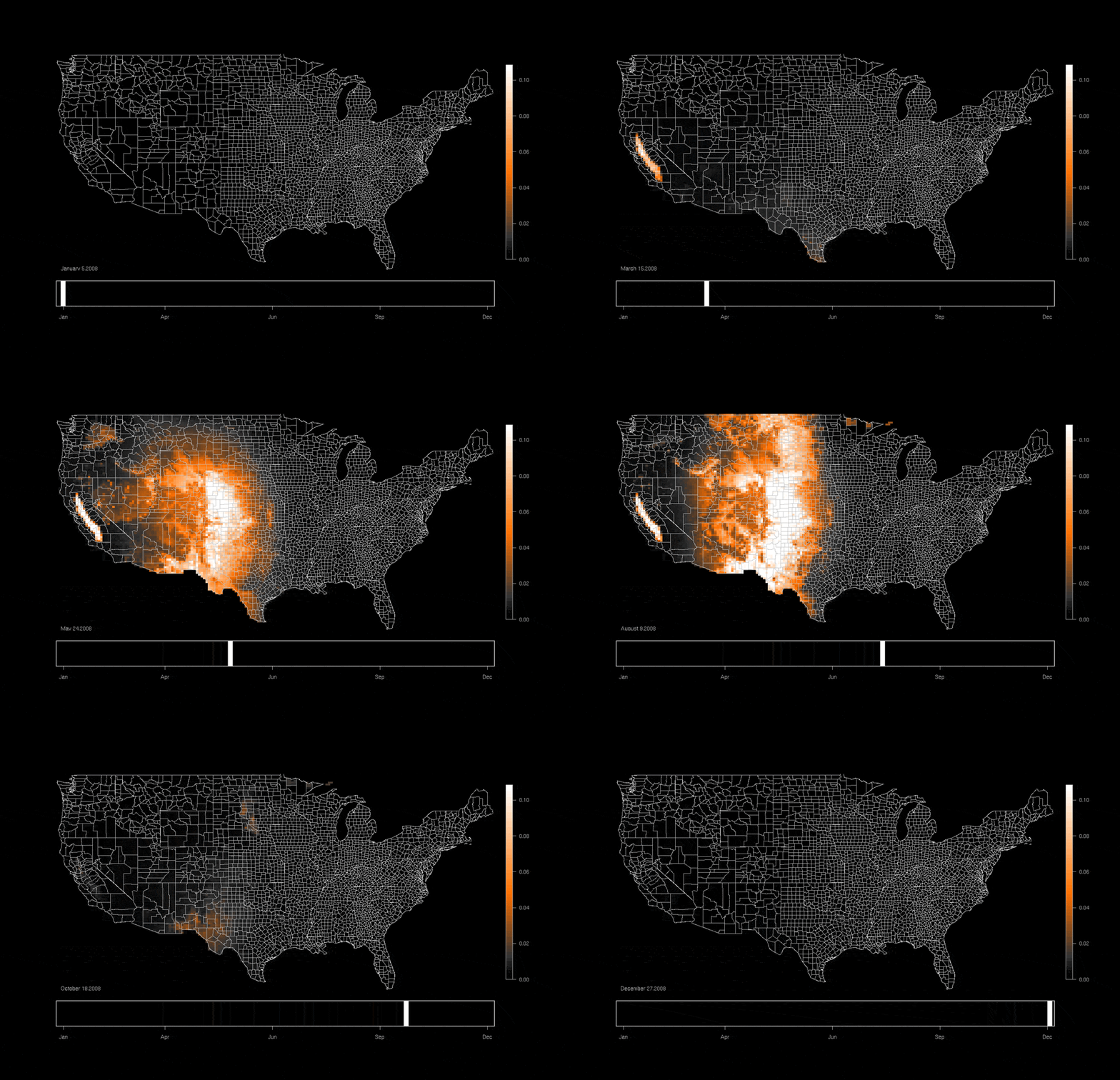
Swainson’s Hawk is the most migratory North American hawk. It breeds commonly on the Great Plains, as well as in grasslands and agricultural areas in western deserts and the Central Valley of California. From September to November it migrates in large flocks south through Mexico and Central America to its wintering grounds in southern South America, returning northward from February to May.
Photo by Terry Sohl
A fascinating pattern can be seen by concentrating on the Central Valley of California. The occurrence of Swainson’s Hawks here has been changing in recent years, as the species appears to have taken advantage of the large areas of agriculture that have become available to them within the last century. This year-round animation shows that Swainson’s Hawks arrive here in early March, more than a month earlier than those arriving on the Great Plains. Swainson’s Hawks feed largely on grasshoppers in summer, and the more temperate climate of the Pacific Coast may permit them to return earlier here (a few even winter in California now). But it also seems likely that these birds are not traveling as far south in winter as the more easterly population. Within the past 20-30 years, Swainson’s Hawks have started wintering in the northern hemisphere, and they now occur regularly in winter in Panama, coastal west Mexico, and southern Baja California–all areas that were forest or desert historically, but have recently been cleared and irrigated for agriculture. With hundreds of birds now wintering in the southern Baja California Peninsula, and an increasingly large late February and March migratory passage in southeastern California, it seems likely that these Pacific Swainson’s Hawks are using these new habitats in both summer and winter, and have rapidly evolved a new migratory strategy to take advantage of them.
Wedding photos, jeeze they sure get boring. No, I’m not hatin on true love, but people, those overly heart-throbby airbrushed galleries make us want to puke. Thanks to this couple for keeping some humor, creativity and originality alive, even on the day of nuptials.
A really beautiful video following Jimmy Chin as he photographs a story of rock climbers in Yosemite for the cover/feature of National Geographic. Amazing camera work.
In an age of spineless US Senators, de-investments in education, and other critical causes being put on the chopping block, it’s satisfying to hear that some states are continuing to show leadership.
California has long been the leader in the states for renewable energy. For sixty years, the state has explored solar and wind energy, and numerous clean energy firms have gotten their start in the Golden State. Now California marks their next step into the 21st Century with the passing of the nation’s strongest Renewable Portfolio Standard.
California’s new renewable energy standard, which requires that utilities purchase 33% clean energy by 2020, is now the highest in the nation. California Governor Jerry Brown signed the mandate into law today, once again reassuring the state’s trailblazing position on the clean energy front.
“With this vote,” American Wind Energy Association CEO Denise Bode said in a statement, “public officials have decided to create thousands more jobs for Californians–jobs in manufacturing, construction, operations and maintenance, and other areas. This action is pro-business and pro-California.”
Indeed — the clean energy sector is one of the few that has continued to grow during the recession. The state was actually reportedly already on the verge of meeting the previous RES, which set 20% clean energy as the standard. Hoping to continue to spur investment in the industry, policymakers bumped up the bar once again.
Here’s the list of state renewable energy standards: (note, the following means that electric utilities in Arizona, for example, will have to get 15% their power from renewable sources)
Arizona: ………………15% by 2025 California: …………..33% by 2030 Colorado: ……………30% by 2020 Connecticut: ……….23% by 2020 D.C.: …………………….20% by 2020 Delaware: ……………20% by 2019 Hawaii: ……………… .20% by 2020 Illinois: ………………..25% by 2025 Iowa: ……………………105 MW Massachusetts: ……15% by 2020 Maryland: ……………20% by 2022 Maine: ………………….40% by 2017 Michigan: …………….10% by 2015 Minnesota: …………..25% by 2025 Missouri: ……………..15% by 2021 Montana: ……………..15% by 2015 New Hampshire: …23.8% by 2025 New Jersey: …………22.5% by 2021 New Mexico: ……….20% by 2020 Nevada: ……………….20% by 2015 New York: …………..24% by 2013 North Carolina: ….12.5% by 2021 North Dakota:* …..10% by 2015 Oregon: ……………….25% by 2025 Pennsylvania: ………8% by 2020 Rhode Island: ……..16% by 2019 South Dakota*: ……10% by 2015 Texas: ………………….5,880 MW by 2015 Utah*: …………………20% by 2025 Vermont*: ………….10% by 2013 Virginia*: …………..12% by 2022 Washington: ………15% by 2020 Wisconsin: …………10% by 2015