

Look across a hillside of conifers this week and you might spot a few that seem to be dying, glowing gold where everything else is green. By November they’ll be bare sticks. They’re fine! They’re larches, and they do this every fall.
A larch has the cones, the tidy Christmas-tree shape and the needles of the pine family. Then every autumn it turns gold and drops all of it, like a maple. Botanists call it a deciduous conifer. Most people driving past assume it’s dead.


How a conifer gets away with it
Run your hand along a larch branch and the first surprise is how soft it is. The needles are short and pale green in summer, and they grow in little starbursts on stubby spur shoots, up to about 35 to a tuft. They look like tiny paintbrushes.
A pine or a spruce coats its needles in wax so they can ride out a winter without drying out, and keeps each one for years. A larch skips the armor. It grows cheaper needles, works them hard all summer, then pulls the nitrogen back out of them before letting go, and starts fresh in spring. A bare tree also gives insects and fire less to work with over the dark months.

Larches aren’t the only conifers that do this, as a reader kindly reminded us. The bald cypress of southern swamps drops its needles every fall too (it’s the one with knobby “knees” poking up out of the water), and so does the dawn redwood, a tree scientists knew only from fossils until living ones turned up in China in the 1940s. China’s golden larch is a cousin different enough to get its own genus. It works the other way, too: holly, magnolia and rhododendron stay green all winter without a single cone. Conifer describes the cones, and evergreen only describes the leaves. But the larches are the ones that cover whole mountainsides, which is why you notice them.
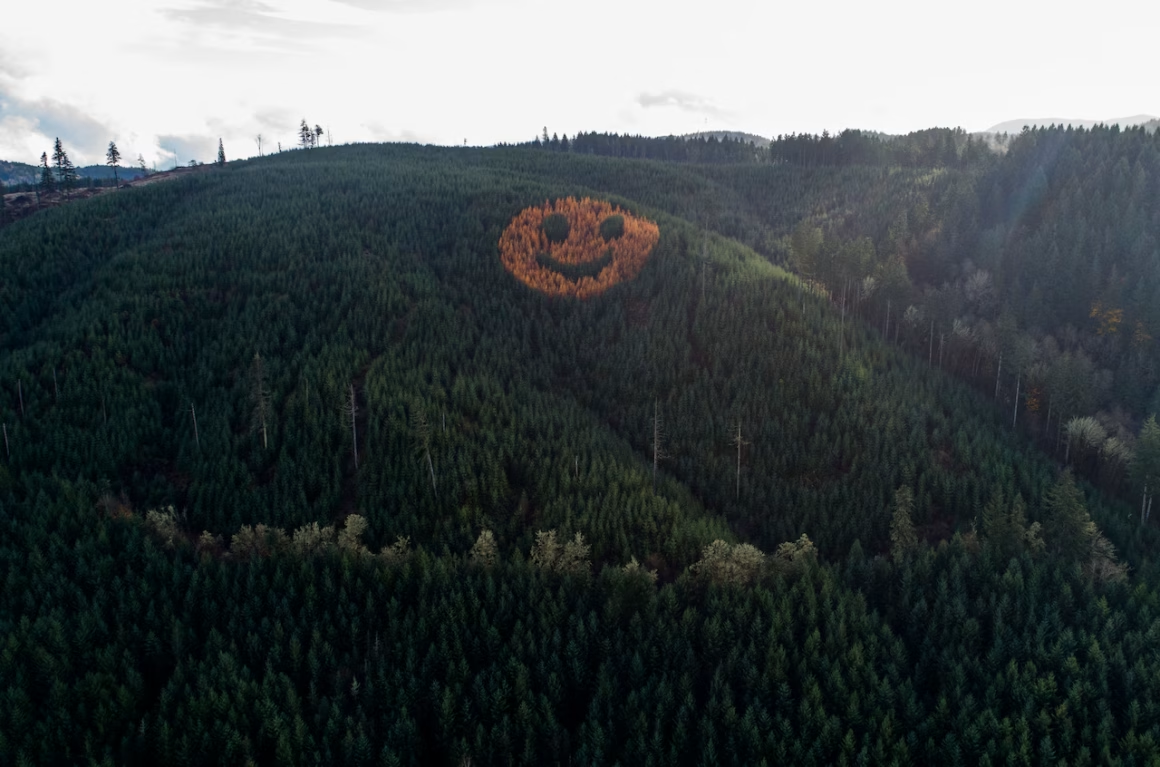
The smiley face on Highway 18
Our favorite larch trick is a couple of hours from our desks. Drive Oregon 18 between Willamina and Grand Ronde in October, and near milepost 25 a hillside grins back at you. The face is about 300 feet across.
When Hampton Lumber replanted the slope in 2011, co-owner David Hampton and forester Dennis Creel saw how visible it was from the highway and decided to have some fun. They planted western larch for the face and Douglas fir for the eyes and the smile. For most of the year it’s just another green hillside. Then October comes, the larches turn, and the whole thing lights up.
“We don’t normally plant larch in these quantities,” the company told KOIN. It was purely for the effect. The hill now gets fan mail from around the world, which might be the best return on a forestry decision we’ve ever heard of.

Come winter the picture flips. The larches go bare and gray, and the dark fir eyes and smile hang on the hill by themselves.

If you want to see it in person, the color peaks around mid-October, so you may catch the last of it this week. There’s a pull-out on the eastbound side of Highway 18, about half a mile east of the Fort Hill Road interchange. Hampton expects the face to come back every fall for another few decades, until the trees are ready for the mill. We first wrote about the hill here.


Larch madness
Farther north, people plan their whole year around this. Alpine larch grows right at treeline in the Rockies and Cascades, where almost nothing else will, and every September Albertans head uphill in what they cheerfully call larch madness. Larch Valley above Moraine Lake in Banff is the famous one, so popular that Parks Canada runs shuttles just to get people to the trailhead.
The trees up there are old. One alpine larch above Colchuck Lake in Washington’s Alpine Lakes Wilderness was ring-counted at 791 years. It has been dropping its needles every autumn since before the printing press.

The tree at the top of the world
Throwing your leaves away every year sounds wasteful, but it’s how the larch survives the harshest places a tree can grow. The Dahurian larch of eastern Siberia is the northernmost tree on Earth, reaching about 72°30′ north at Ary-Mas on the Taymyr Peninsula. Around Oymyakon and Verkhoyansk it lives through temperatures below −70°C.
It forms enormous forests across the taiga, rooted in thin soil over permafrost, and taken together with its close varieties it may be the most numerous conifer on the planet. So the most common evergreen-looking tree in the world might not be an evergreen at all. We love that!
The wood Caesar couldn’t burn
The Romans had their own larch story. Vitruvius, the architect whose ten books shaped Western building for centuries, tells of Julius Caesar’s army in the Alps laying siege to a fort called Larignum. In front of its gate stood a tall tower of larch. Caesar’s soldiers piled firewood and torches around it, the flames rose, and when the fire died down the tower was still standing, unhurt.
It cannot be kindled with fire nor ignite of itself.
Vitruvius on larch, The Ten Books on Architecture, translated by Morris Hicky Morgan
According to Vitruvius, that’s even how the wood got its name: the fort was Larignum, so the timber became larigna. He also praised its bitter sap for keeping rot and worms away. Historians can’t find any other record of a place called Larignum, and larch will certainly burn if you try hard enough. But dense, resinous larch really is tough and slow to rot, which is why builders still reach for it for cladding, decks and boats.
See them before they go
Out east and across Canada, look for tamaracks in bogs and wet lowlands, where the ground is too soggy and sour for most trees. Out west, look for western larch scattered through the mountain forests, and alpine larch near treeline. Anywhere else, check a park or an old estate garden; European and Japanese larch have been planted widely.

Just don’t wait. Most larches have dropped their needles by about Halloween, and then they really do look like dead trees until spring. When the new needles come back in April, they’re the softest green you’ll see all year.

Want more of the season while it lasts? Follow the color across the continent on our fall foliage map, meet the most colorful trees of fall 2026, or read about the year every oak drops its acorns at once and how trees sleep at night.


