On 5 May 2022, inside the Mercedes-Benz Museum in Stuttgart, RM Sotheby’s sold a 1955 Mercedes-Benz 300 SLR Uhlenhaut Coupé to a private collector for €135 million. That’s more than €90 million above the previous record for any car. The money is the headline. The design story is better, and it runs back more than a century, through a handful of rare cars where engineering decisions ended up deciding what the car looked like.
Here are the four we’d put in front of anyone who thinks car design is just styling.
1903: the Sixty, a car shaped like a car

The name came first. Emil Jellinek, the Austro-Hungarian consul in Nice, talked the Daimler company in Cannstatt into building a fast 35 hp car in 1900 and had it named after one of his daughters, Mercedes. Wilhelm Maybach and Paul Daimler followed it with the 60 hp car of 1903, the Sixty.
Look at the parts list and you’re looking at the template for most cars that followed: a pressed-steel chassis frame, a gate gear change and a honeycomb radiator up front. The engine was 9,236 cc. That year Camille Jenatzy drove a Sixty to victory in the Gordon Bennett race in Ireland, averaging 49.2 mph over about 327 miles.
Only five 60 HP Simplex cars are known to survive. The one pictured here wears Roi des Belges coachwork by J. Rothschild et Fils of Paris, a body style named for King Leopold II of Belgium, who had one of his cars built the same way. It sold at Amelia Island in 2024 for $12.1 million.
1954: the Gullwing, where the frame drew the doors
The 300 SL started as a racing car, the W194, which won Le Mans and the Carrera Panamericana in 1952. Max Hoffman, Mercedes’ importer in the United States, saw what wealthy Americans wanted and committed to 1,000 road cars. So the production 300 SL made its debut not in Frankfurt or Geneva but at the New York auto show in February 1954.
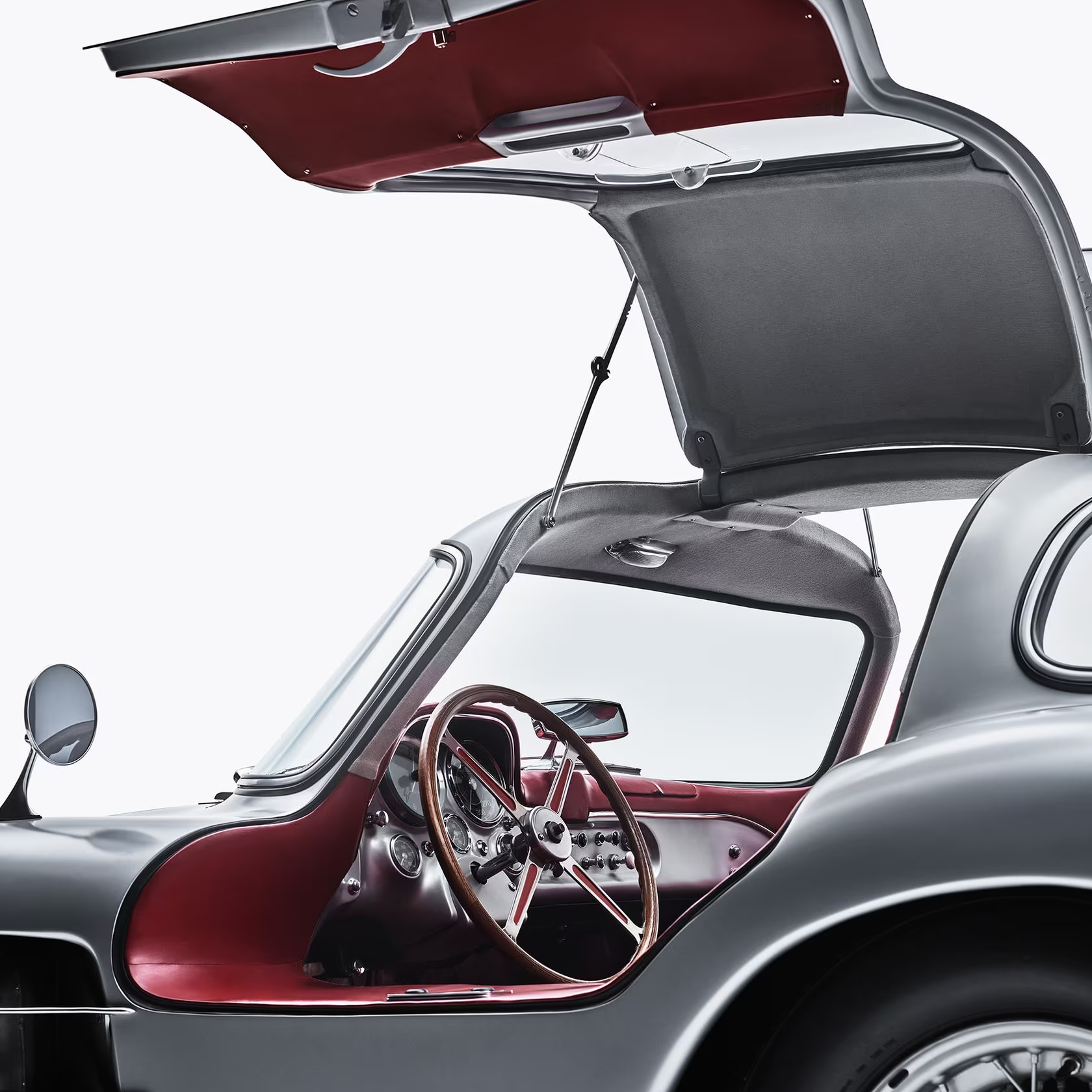
Those doors weren’t a styling flourish. The 300 SL was built on a tubular spaceframe with high, deep sills along each side, and an ordinary hinged door simply wouldn’t work. Hinging the doors in the roof was the practical answer, and it happens to be one of the most recognizable shapes in automotive history. It’s our favourite example of a constraint doing a designer’s job for them!

Underneath, Bosch mechanical direct fuel injection lifted output from 175 to 240 hp, and the car could reach about 260 km/h, which made it the fastest production car of its day. Mercedes built 1,400 coupés between 1954 and 1957, then 1,858 roadsters through 1963. The roadster lost the gullwings and gained conventional doors, which tells you how much the frame had to change to allow them.

1954 to 1955: the racers, and the coupé that stayed home
The 300 SLR grew out of the W196 R Grand Prix car, its engine enlarged to three litres for sports-car racing. In 1955 Stirling Moss and the journalist Denis Jenkinson won the Mille Miglia in one at a record average of 157.65 km/h over 1,600 km. The W196 R itself carried Juan Manuel Fangio to wins in the 1954 German and Swiss Grands Prix. That exact car sold at Goodwood in July 2013 for £19,601,500, a record at the time.
Then came Le Mans. In June 1955 Pierre Levegh’s 300 SLR was launched into the crowd after a collision, killing him and 83 spectators, still the worst accident in motorsport. Mercedes withdrew from racing at the end of that season and stayed away from major competition for about three decades.

That’s why the two closed 300 SLR coupés matter. Built by the racing department in 1955 for a season that never happened for them, they ended up as road cars, and the chief engineer Rudolf Uhlenhaut used one as his personal transport. The story goes that he once drove from Munich to Stuttgart in just over an hour. It was capable of nearly 290 km/h. Treat the anecdote as legend. The car is real!
Mercedes kept both for nearly seven decades. After the 2022 sale, the proceeds set up the Mercedes-Benz Fund, offering scholarships in environmental science and decarbonisation, and the buyer agreed the car would still be shown publicly on special occasions. The second coupé stays in the company’s collection on display at the museum. Which is the right ending, honestly. One for the market, one for everybody.
We covered the sale itself when it happened in The World’s Most Expensive Car, and the 300 SL Gullwing has had its own moment here too. For where Mercedes design is heading next, see its new Art Deco design language.