It’s sometimes hard to believe that something this clean, this confident, this unmistakably modern could be closing in on a century old. But that’s the peculiar magic of truly timeless design: it doesn’t age so much as it recedes into the background of daily life, quietly doing its job on movie posters, corporate letterheads, and even a plaque left on the surface of another world. In the history of typography, few faces have earned that kind of staying power quite like Futura.

Futura was drawn in 1927 by the German type designer Paul Renner, commissioned by the Bauer Type Foundry as its answer to the wave of new geometric sans-serifs sweeping German type design at the time — a race Renner was somewhat annoyed to lose the sprint on, since Ludwig & Mayer’s Erbar reached foundries first, in 1926. Where Erbar has largely faded into type-history footnotes, Futura became the one the world actually kept using.
Built almost entirely from strict circles, triangles, and straight lines, Futura’s severe geometry placed it visually alongside the Bauhaus design movement of the same decade — though, contrary to a popular assumption, Renner was never a member of the school and kept a deliberate distance from it. His own politics, in fact, cut sharply against the regime that would soon claim so much of German design for its propaganda. Renner published a pamphlet warning against “cultural Bolshevism” before the Nazi party seized power, spoke out publicly against it at a public forum in Munich, and was arrested and dismissed from his teaching post in 1933, eventually fleeing to Switzerland. Futura, in other words, was born from a designer who wanted nothing to do with the extremism his adopted country would soon embrace — a fact easy to forget when you’re looking at a typeface this cheerfully rational.

Here’s a beautiful short film about Futura and the discipline behind it.


Renner designed Futura to be stripped of anything decorative — no flourishes, no unnecessary curves, nothing that didn’t earn its place on the page. That restraint is exactly why it has traveled so well across nearly a century of wildly different uses: airline logos, film title cards, subway signage, and — most improbably of all — the surface of the Moon. Nowhere is its adoption more visible today than in the films of Wes Anderson, who has used Futura Bold as a kind of directorial signature across his catalog, most famously in the poster and production design for The Royal Tenenbaums, turning a 1920s German type specimen into unmistakable contemporary shorthand for a very particular cinematic sensibility. It’s the kind of crossover between graphic design and film that Futura seems built for.

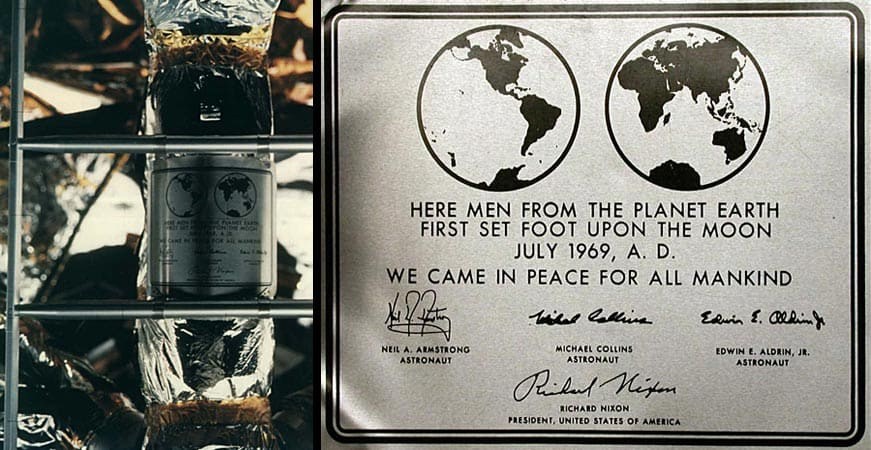
But Futura’s single strangest, most quietly moving job came in 1969, when it was chosen for the inscription on the plaque the Apollo 11 astronauts left behind on the lunar surface — a small stainless-steel rectangle etched with a map of the Earth and the words “We came in peace for all mankind,” signed by the crew and President Nixon. NASA’s designers reached for Futura precisely because it read as clean, rational, and forward-looking rather than nationalistic or ornamental: a typeface built on pure geometry, left on a world with no atmosphere to erode it, for as long as anyone can imagine returning to read it.
Here’s to the next 85 years, Futura — and to the hundred after that. In a field as prone to fashion as design, it’s a rare thing to be able to say, with real confidence, that something will still look exactly right in 2097.