Tag

Jony Ive

Browsing

Ferrari’s upcomingΒ LuceΒ is not just another electric pivot. It feels like a reset button for what a car interior can be.

Interior view of a Ferrari car dashboard, featuring a sporty steering wheel with controls and a digital display panel showing speed, power, and other metrics.

Working with legendary designers Marc Newson and Sir Jony Ive fromΒ LoveFrom, the team behind the cabin has stepped away from the all-screen everything trend and leaned hard into touch, material, and presence.

Close-up view of a Ferrari dashboard display showing speed, power output, and other metrics, with dials and buttons for controlling various functions.

The result is an interior that feels incredibly crafted, tactile, and bespoke, not programmed.

Metal replaces gloss. Real switches replace buried menus. Controls look like objects you want to use, not icons you have to hunt for. It is much less like a tablet, and more like a premium instrument.

Close-up of a modern digital clock displaying the time as 10:10, temperature as 27Β°C, and additional weather data on a sleek device interface.

There is a clarity to it that feels almost architectural. Surfaces are calm. Displays are integrated, not dominant.

The multi-graph has two tactile buttons that elegantly animate between views. It’s clear that Jony Ive’s sleek design influence at Apple carry over here.

Take the shifter, a single piece of glass with a smooth, satisfying heft. It required Corning to develop a new formula of glass called Fusion 5, and then went through a painstaking process of drilling 13,000 laser holes to allow for hidden illumination.

Close-up view of a car's center console featuring a Ferrari logo, gear shifter, and control buttons.

Light moves across materials in a way that makes the cabin feel alive without shouting for attention.

Close-up of a car's dashboard control featuring a prominent 'Launch' button with an orange ring, surrounded by various other controls and indicators.

It is a refreshing move fromΒ Ferrari. Instead of using electrification as an excuse to add more tech spectacle, Luce suggests subtraction.

Close-up of a Ferrari gear shift console featuring a logo, gear selection indicators (R, N, D, P), and various buttons.

Take the shifter, a single piece of glass with a smooth, satisfying heft.

It required Corning to develop a new formula of glass called Fusion 5, and then went through a painstaking process of drilling 13,000 laser holes to allow for hidden illumination.

It’s a real departure from the current automotive landscape, and hopefully will inspire some trends in the coming years.

Fewer distractions. Better objects. A stronger connection between driver and machine.

Close-up view of a control panel featuring various buttons and indicators, including temperature setting, fan speed, and function icons, set against a dark background.

If this is where high performance interiors are heading, the future looks less like a gadget showroom and more like a beautifully considered studio on wheels.

Close-up of a Ferrari steering wheel with digital display, showcasing speed and performance gauges.
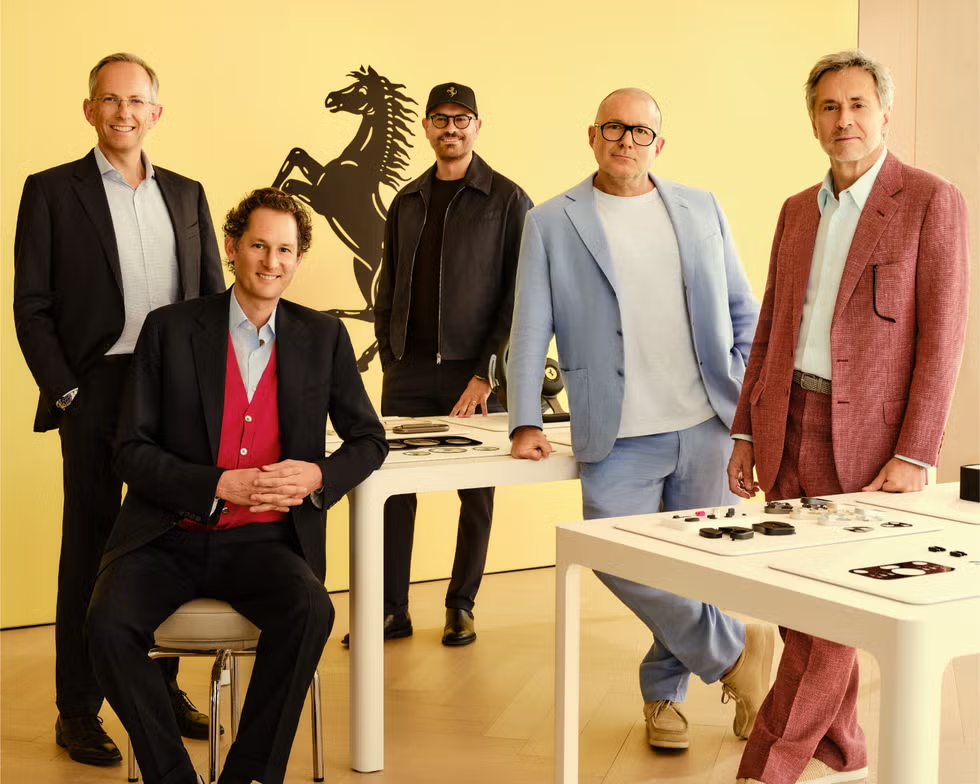
From left to right; CEO of Ferrari Benedetto Vigna, Ferrari Chairman John Elkann, Ferrari Design Director Flavio Manzoni, Lovefrom founder Jony Ive, Lovefrom co-founder Marc Newson.Β 
A sleek red car parked on a rocky terrain with mountains in the background, showcasing its modern design and sporty features.

The exterior of the Luce shows Ferrari’s latest design language for their four-door EV.

Fewer details have been released about the car’s specs, but more will be shared soon, and we imagine this heralds a new era for Ferrari’s design, and their technology.

A diagram of a car dashboard featuring the steering wheel, control panel, and various input and output elements labeled accordingly.
Close-up of a luxury car seat in brown leather against a black background.
Close-up of a sleek dashboard with the brand name 'LUCE' and an air vent, featuring a modern design against a dark background.

Read more on Road & Track. Images courtesy Ferrari and LoveFrom.

You might also like: Imagining Christmas Trees Of Endless StylesFly Through One of the World’s Largest WaterfallsCity Logos Designed in Charming Retro 80s Style

LoveFrom, the semi-secretive design firm founded by former Apple Chief Design Officer Jony Ive has teamed with Balmuda to reveal theΒ Sailing Lantern.

It’s a portable lighting object born from Ive’s lifelong affinity for sailing and a shared obsession with the poetic potential of tools.

A modern, stylish table lamp with a transparent glass body and metallic accents in chrome and gold.

Crafted for maritime conditions, the lantern is engineered from polished, textured glass encased in precision machined stainless steel, tipping the scale at 1.5 kg.

It evokes the silhouette of vintage Fresnel lamps, yet Ive insists it is not nostalgic.

Close-up of a modern lamp featuring a transparent glass design with layered ridges and a glossy metallic base, adorned with a decorative control knob.

The light itself is a slow, deliberate choreography of color. As you dial its brightness, the glow shifts from soft red tones toward white blue, mimicking the behavior of flame.

When switched off, it fades gently, not snapped off like a switch but extinguished like a fire.

/

Every detail is thoughtful. A flower shaped dial clicks under your fingers, the lanyard is crafted from textured polyester engineered to resist salt, sun, and oil, and a corrosion resistant stainless button secures it.

A top view of a stylish sailing lantern with a metallic finish, featuring a brass ring and a circular light element in the center.

Ive and Balmuda emphasize that this lantern is built to age. Its surface will bear scratches, but those marks will deepen its character over years of use.

What makes this more than a beautiful object is the collaboration. Ive has spoken openly about the importance of who you work with, not just what you make.

Close-up of a sleek metal lantern base with a beige strap and a circular button labeled 'SAILING LANTERN'.

Balmuda’s founder, Gen Terao, describes the process as arduous. To meet Ive’s exacting standards, his engineers had to push beyond their comfort zone. The reward is a tool that is both technically refined and emotionally resonant.

Close-up of a contemporary lamp featuring clear, ridged glass and a gold metal frame.

So what does all of this sophistication, craftsmanship, and technology cost? $4800 USD, on the Balmuda website.

Apple’s Chief Design Officer, Sir Jony Ive, has stepped down from his role at the tech giant, marking the end of an era of design-thinking, and cutting-edge industrial design.

93WPR17DEC117.pdf

In his 20+ year career at Apple, he pioneered and lead the design of some of the world’s most influential and transformative products. Working directly alongside the late Steve Jobs, Ive had a slew of huge breakout successes, from the original iMac, to the best selling product of all time, the iPhone.

We were suckers for his smooth product introduction videos, describing the design thinking and industrial processes, in his flawless British accent.

Leaving Apple to pursue his own company, entitled Loveform, Ive will continue to work with Apple on their design projects. Yet it’s impossible to deny that it’s the end of an era for the company that wanted us to Think Different.

The behemoth today is much more interested in selling you iCloud and Apple Music subscriptions, than continue to pioneer new consumer products, with industry leading design and attention to detail.

Jony-Ive-design-legacy-moss-and-fog

Below we take a look at several of the groundbreaking products that Jony Ive was responsible for the design of. We’ll be sad to see him leave the company, although his legacy is firmly intact, having pushed our collective tastes towards a more thoughtful, minimal, and well-crafted place. Thank you, Jony!

jony-ive-best-apple-designs-ipod-iphone-imac_dezeen_936_col_0
The original ‘jellybean’ iMac, which coincided with Steve Jobs return to the company.

jony-ive-best-apple-designs-ipod-iphone-imac_dezeen_936_col_0-1
The equally colorful iBook notebook.

johhny-ive-best-apple-product-iphone-ipod-first-generation-ipod-first-gen-photo-chris-murphy-col_1-1
The original iPod with scroll wheel and black and white screen. Remember this gem?

apple1
The “lampshade” iMac that introduced a flat-panel display.

original-apple-iphone-design-news-hero
The original iPhone, the product that would go on to make Apple the most valuable in the world, and sell hundreds of millions of copies.

johhny-ive-best-apple-product-iphone-ipod-imac-air-col_1
The aluminum MacBook Pro, ushering in a new era of metal and glass design to Apple.

ipad
The original iPad, Steve Jobs’ last product introduction before his death, continued the clean minimal design.

dezeen_Apple-unveils-iOS-7-software-designed-by-Jonathan-Ive-20
iOS 7, the iPhone’s software platform, ushered in a new, flat design language, lead by Jony Ive, and showcasing his design flourishes.

jony-ive-best-apple-designs-ipod-iphone-imac_dezeen_936_col_2
The original Apple Watch, a classic design that would go on to become the most popular wearable in the world.

apple-park-john-ive-architecture-offices_dezeen_2364_col_2
Apple Park, Jony Ive’s last ‘product’, their incredibly advanced and minimal headquarters in Cupertino, California.

Quick Facts: Name: Apple Park. Location: One Apple Park Way, Cupertino, California. Architect: Foster + Partners (Norman Foster). Area: 2.8 million square feet. Employees: ~12,000. Opened: April 2017. Construction cost: Approximately $5 billion. Centerpiece: The Ring β€” a circular main building 1.6km in circumference. Also on campus: Steve Jobs Theater, 9,000 trees, a 100,000 sq ft fitness center, and underground R&D labs.

apple-park-moss-and-fog-1

Steve Jobs spent some of his last working months personally overseeing the design of Apple Park. He died in October 2011. The campus opened in April 2017. What was completed is one of the most ambitious corporate headquarters ever built: a single circular building 1.6 kilometers in circumference, set inside 175 acres of landscaped grounds, housing 12,000 employees under one continuous roof of curved glass.

93WPR17DEC118.pdf

What Norman Foster Designed

Foster + Partners’ design centers on “The Ring” β€” a four-story circular structure with no straight lines and no conventional entrance. The building wraps around a central courtyard of gardens, orchards, and meadows. The exterior walls are almost entirely glass, using the largest curved glass panels ever manufactured at the time of construction. Natural ventilation handles the climate for nine months of the year without mechanical systems.

apple-park-moss-and-fog-4

93WPR17DEC122.pdf

Steve Jobs Theater

The campus’s most architecturally dramatic building is the Steve Jobs Theater, a 1,000-seat underground auditorium whose only visible structure above ground is a cylindrical glass pavilion. The roof β€” a carbon fiber disc 20 meters in diameter β€” appears to float above the glass walls. It’s where Apple announces its major products, and it manages to feel appropriately monumental without being ostentatious.

apple-park-moss-and-fog-6

apple-park-moss-and-fog-7

The Environmental Ambition

Apple Park is powered by 100% renewable energy, drawing on 17 megawatts of rooftop solar β€” the largest onsite solar installation of any corporate campus in the world at opening. The 9,000 trees planted on the grounds include many native California species that were in danger of disappearing from the region. The landscape itself is designed to require minimal irrigation once established.

apple-park-moss-and-fog-8

apple-park-moss-and-fog-9

A Campus That Earns Its Ambition

Corporate campuses often promise more than they deliver architecturally. Apple Park is genuinely exceptional: a building that treats its scale as an opportunity rather than a challenge, that makes sustainability central rather than cosmetic, and that will likely still be considered one of the finest examples of 21st-century corporate architecture decades from now.

apple-park-moss-and-fog-10