

Quick Facts: Artist: Charles Schridde. Client: Motorola. Era: 1950s and 1960s. Medium: Editorial illustration for print advertisements. Subject: Visions of domestic life in a technologically advanced future. Why they matter: They captured a cultural moment of genuine optimism, and many predictions were surprisingly close.

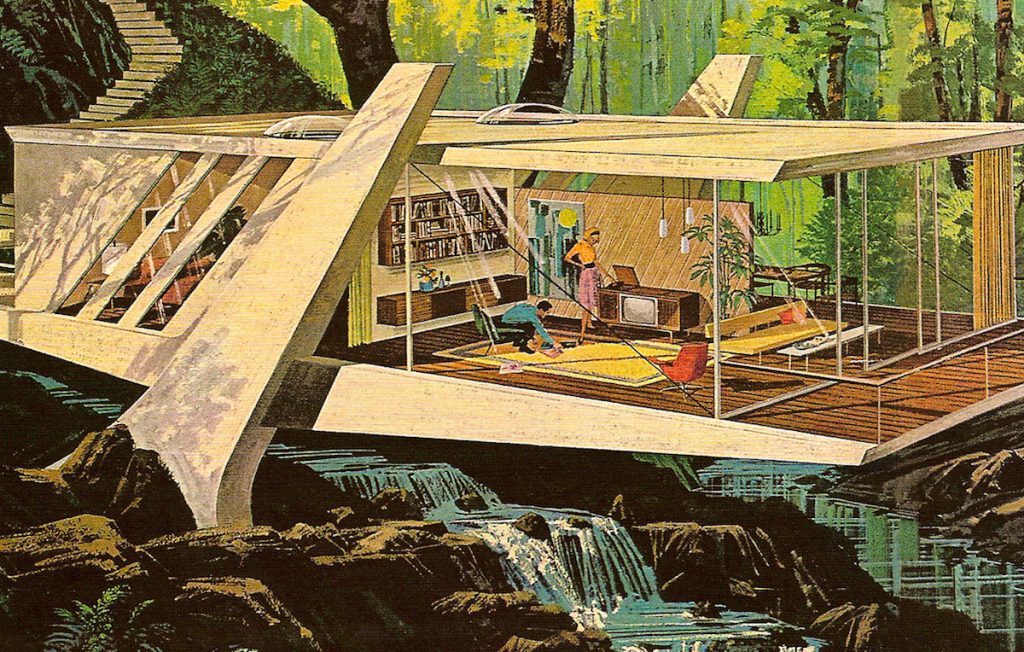
In the 1950s and 60s, Motorola hired illustrator Charles Schridde to paint the future. Not science fiction. Not spaceships. The future of the living room, the kitchen, the den. Domestic life with technology woven in so naturally it felt inevitable. Looking at these images now, what’s striking is how much he got right.

Who Was Charles Schridde?
Schridde was a commercial illustrator working in the postwar American tradition of aspirational advertising art. His Motorola commissions gave him a specific and unusual brief: paint how families will actually live with electronics in the home of tomorrow. The results were less about gadgets and more about atmosphere: open-plan rooms, integrated screens, a confident sense that modern design and modern technology belonged together.


What He Got Right
The screens embedded in walls. The centrality of audio and visual media in every room. The open, flowing domestic architecture that treats technology as furniture rather than novelty. These weren’t wild guesses. They were extrapolations from genuine trends, drawn with enough craft that they still feel coherent today.

What He Got Wonderfully Wrong
The clothes. The formality. Families hosting cocktail parties around their new television sets. Men in suits watching the news in rooms that look like they were designed by Mies van der Rohe. The social dynamics are pure 1950s, even as the technology reaches toward something much later. That contrast is exactly what makes these illustrations so worth studying.


Why These Images Still Matter
Every era imagines its future through the lens of its present. Schridde’s illustrations are a perfect record of mid-century optimism: the belief that better technology would lead to better living, that design and domesticity were partners in building something genuinely good. Even 70 years on, that spirit is hard not to find moving.


Featured in Retrofuturism: The Future We Were Promised, our visual guide to the tomorrows the past imagined.


20 Comments
Pingback: Q Marks the Spot 197 (June 2025 Treasure Map) – Quaerentia
Unfortunately we don’t all live by the ocean.
That’s a great idea, thanks for the insightful comment!
Very nice! There’s an active, open and proper ethos to mid century design that is somehow uncluttered and pleasing to the eye. Perhaps moss and fog would encourage readers to try their own hand, sketches, drawings at a modern take on mid century modern aesthetic scenes? Perhaps architectural themed photos? Should be fun!
Good luck getting the permits to build that!
They apparently predicted Close Encounters of the Third Kind and having a mountain with plants in your living room.
Anyone for more glass walls and concrete pylons? More and more glass walls and pylons? Even MORE glass and concrete than that? It’s the future dude!
Funny, in these scenes everything looks futuristic *except* for the televisions. A box with a screen on the front? On a stand? LOL!
That’s insightful, thank you for the comment!
It seems like they’re finally coming! Check out technology like this: https://mossandfog.com/the-volonaut-airbike-brings-the-flying-speeder-from-star-wars-to-life/
Ha! We’ll have to look that one up. You sound knowledgeable on the subject.
Where are the hover cars that were predicted in my 1950’s grade school weekly reader.
I’ll bet a lot of people in the ‘50s went out and bought stock in Drackett – the company which owned Windex at the time…
We seemed to think that we would bring as much nature close to our living spaces.
But they didn’t consider our population growing so fast & in America inner cities didn’t have the room or money for that style of living. I would have thought that there would have been more about outer space living & moving sidewalks in the cities, that sort of stuff.
Apparently, they envisioned all of us living on waters edge, and still having console TV sets!
But there is a hanging TV, tho all the pictures on the tubes are black and white!
They couldn’t have predicted the slobs Americans have turned into!
Wow! How off they all were!
Modern architecture is a blah as ever!
Many of the architecture features shown here can be seen in home tours during mid-century modernism week in Palm Springs every February.
It is interesting to note that they weren’t predicting the development of flat screen TVs at that time. I do know that the Monsanto House of Tomorrow at Disneyland in the 50’s did have a small flat screen B&W tv.
Beautiful and awesome at the same time3.