


In today’s day and age, online privacy is more important than ever. People live increasingly digitized lives, and even if you don’t realize it, you’ll have a large digital footprint that extends far across the internet.
The internet has always been a double-edged sword. As far back as people started to use it in the home, the risks of data breaches, scams, and hackers were ever-present. Back in the 1990s, the major threats were those associated with email, and usually, the worst that could happen was getting a computer virus. Today, though, the risks reach far beyond this: from having your life documented on social media to relying on internet banking for transactions and general financial management, there’s a lot more at stake in 2026.
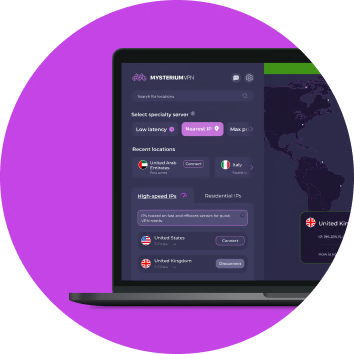
One of your best tools for maintaining your privacy and security in the digital age is a Virtual Private Network (VPN). A VPN encrypts your internet connection, hiding your IP address to provide an extra layer of anonymity and protection online.
Not all are created equal, however. In this review, you’ll learn about Mysterium VPN – one of the most popular, well-regarded options. Read on to discover whether or not this is the ideal choice for you.
Image Credit: Mysterium VPN
How is Mysterium VPN Different?
So, you know what a VPN is – at least in the more general sense. But what does this do differently?
Even though it’s relatively new, Mysterium is grounded in a fundamental framework that’s been established over decades of research for protecting user anonymity. Just like any other reputable VPN, this is, first and foremost, a privacy-focused service. The difference lies in how it uses a decentralized network to enable a greater variety of residential IP addresses alongside traditional data center types. This allows user traffic to blend in better, meaning you get fewer site blocks, a more stable browsing experience, and greater precision.
It’s worth mentioning, however, that Mysterium VPN is not strictly a decentralized VPN (dVPN). It uses a decentralized structure, but unlike a traditional dVPN, other VPN users are not used for the IP pool. This makes for an overall more secure experience that offers the best of both worlds.

Mysterium’s Unique Approach
The best thing about Mysterium VPN is this use of residential IPs. The reality is that VPNs that rely heavily on data centres often make for a much more awkward browsing experience than non-VPN browsing. These types are often flagged by the areas of the internet you want to access most frequently, such as big websites, streaming services, and a plethora of the most popular applications. By utilizing residential IPs, though, these sites and apps don’t assume you’re using a VPN, and you avoid the most commonly encountered hurdles of maintaining your anonymity online.
Mysterium also uses a bespoke ecosystem for sourcing its IPs, meaning you get a quality option each time. This is a usability feature that few of the main VPN providers offer. Given that the IPs come from a distributed network, this can occasionally make for a dropped connection here and there, but it’s a rare occurrence; for the most part, it’s a vastly superior way of doing things.

Image Credit: Mysterium VPN
Privacy at the Forefront
Any VPN worth its salt should have privacy at the forefront, and thankfully, Mysterium delivers on that front.
The service uses ChaCha20 encryption, which ensures a very high standard of protection while simultaneously maintaining the speed modern users have come to expect. They also provide DNS and IP leak protection, making for a water-tight system with a very low risk of a user’s data becoming exposed and leaked online.

At the same time, Mysterium VPN utilizes a kill switch, meaning that your connection is cut immediately if there are any connection issues, drastically reducing the risk of data leaks. This was traditionally only something companies and organizations dealing with highly sensitive information needed, but today, given the amount of data transferred from a residential user at any given time, it’s an essential feature for everyone.
Another reassuring fact is that the company is part of the i2Coalition, which was set up to make sure that those who develop the key pieces of internet infrastructure people use on a daily basis have a say in the development of public policy. It’s vital that the internet privacy services you use are aligned philosophically with the end user’s rights, so knowing Mysterium is an advocate here is a big plus.

Image Credit: Mysterium VPN
Pros and Cons
Now that you have a better idea of what Mysterium VPN is about, let’s have a look at some of the key pros and cons to give you a better picture.
Pros
Access to Thousands of Residential IPs: Mysterium VPN offers a pool of over 7500 residential IPs spanning 100+ countries, ensuring that no matter what you’re doing, you’ll have the global reach and reliability you need.
Supports up to 15 Simultaneous Device Connections: This is crucial for those engaged in small projects or business work, or those who live in a particularly large household.
No-Logs Policy with GDPR Compliance: The fact that Mysterium VPN offers this guarantees, from a legal standpoint, that nothing you do online while using the service is stored and tracked.
Affordable Pricing: Pricing starts at $2.59 per month, which strikes a nice balance between providing premium features and keeping the cost affordable for the average user.
Cons
Linux Support is Still in Development: If you use a Linux machine, you’ll have to wait a little for full support, which will limit usage for some.
Minor Speed Inconsistencies: You may experience a couple of minor speed issues depending on node availability.

The Verdict
Having a VPN in 2026 isn’t a luxury – it’s a necessity if you care about your digital footprint.
For most people, Mysterium VPN is an excellent option for advanced internet security and anonymity in 2026. It’s fast, safe, and with a forward-thinking philosophy at its heart, and barring a couple of niggles, it’s without compromise.


