Heatherwick Studio has shared a fresh vision for the Daegyo Apartments in Yeouido, Seoul.
The plan would replace a 1975-era complex with four new residential towers along the Han River, shaped with soft, rolling rooflines that nod to the mountains around the city.
Instead of the usual straight, repeatable high rise look, the proposal leans into curves and texture, aiming for something that feels more warm and lived-in.
The redevelopment would grow the site from 576 homes to about 900, with design input gathered from hundreds of resident union members.
At street level, the idea is to make the place calmer and more walkable. Portions of the site edge are lifted to help block traffic and create sheltered paths, plus sunken courtyards that feel like little breaks from the city.
A generous ground floor is planned to be open to residents and the public, with community facilities like play areas and welfare services woven in.
More Thomas Heatherwick and Heatherwick Studio on Moss and Fog
The intersection of technology and society has long been a hallmark of South Korean identity. From the rapid rise of “pali-pali” (hurry-hurry) culture to becoming the world’s most wired nation, South Korea serves as a global laboratory for how digital integration alters human behavior.
As the country fully reopens its borders in the post-pandemic era, a new digital layer is being added to the traveler’s experience, one that prioritizes seamless entry and high-tech immersion. For the modern visitor, understanding this shift begins before they even land, often starting with the transition to a Korea arrival card online to streamline the bureaucratic process.
The Evolution of the “Smart” Traveler
In years past, the experience of entering a new country was defined by tactile friction: paper forms, ink stamps, and long queues. However, South Korea’s social fabric is increasingly defined by the elimination of these minor inconveniences. The government’s push toward a paperless society isn’t just about efficiency, it’s a reflection of a societal value system that prizes time and technological fluency.
By moving essential documentation like the arrival card into the digital sphere, South Korea is setting a precedent for “frictionless tourism.” This allows visitors to bypass the frantic scramble for a pen on a descending aircraft and instead focus on the cultural immersion that awaits them.
This digital-first mindset is explored deeply in various design and lifestyle contexts, much like how modern architecture and urban planning in Seoul reflect a desire to blend the organic with the futuristic.
Society in the Age of Hyper-Connectivity
Once on the ground, the impact of South Korea’s digital society becomes even more apparent. The concept of “Untact”, a term coined in South Korea to describe a growing preference for services without direct human contact, has permeated almost every industry. From robot-serviced cafes in Gangnam to fully automated kiosks in convenience stores, the social landscape is shifting.
While some sociologists worry that “untact” culture might lead to increased isolation, others argue it provides a new form of social agency. For travelers, it means the ability to navigate a foreign culture with a level of independence never before seen. High-speed 5G networks and ubiquitous Wi-Fi mean that language barriers are softened by real-time translation apps, and the complex Seoul subway system is mastered via hyper-accurate navigation software.
A Culture of Aesthetics and Efficiency
South Korean society is also unique in how it treats the aesthetic of technology. It is not enough for a tool to be functional, it must be beautiful and integrated. This is evident in the country’s “Smart City” initiatives, such as Songdo, where waste management, traffic control, and energy usage are all handled by an invisible digital nervous system.
This societal obsession with integration is what makes the country so attractive to the “digital nomad” generation. The ability to work from a traditional hanok (Korean house) while utilizing some of the fastest internet speeds on the planet creates a fascinating juxtaposition.
It represents a society that honors its 5,000-year history while simultaneously sprinting toward the 22nd century. According to reports on global digital competitiveness by the IMD, South Korea consistently ranks at the top, particularly in terms of future readiness and technological infrastructure.
The Human Element in a Digital World
Despite the high-tech veneer, the heart of South Korean society remains deeply rooted in Jeong, a uniquely Korean sense of social affinity and emotional attachment. Technology hasn’t replaced Jeong. It has merely changed its delivery method. Social media platforms like KakaoTalk are the lifeblood of Korean communication, used to organize massive community events or simply to check in on elderly relatives.
For the international visitor, participating in this digital ecosystem is essential for a “local” experience. Whether it’s using an app to join a queue at a popular Michelin-star BBQ joint or using digital platforms to book a temple stay, the technology acts as a bridge rather than a barrier.
Preparing for the Journey
As the world moves toward more integrated travel systems, the move toward digital entry requirements is becoming the global standard. The International Air Transport Association (IATA) has frequently highlighted how digitalized travel credentials improve the passenger experience and border security. South Korea’s adoption of these systems is a testament to its role as a global leader in innovation.
For those planning to visit, the shift to digital isn’t just a matter of convenience, it is an invitation to join one of the most forward-thinking societies on earth. By handling the administrative side of travel, such as securing your arrivals documentation online before you depart, you free up your mental bandwidth to appreciate the nuances of Seoul’s neon-lit streets or the quiet dignity of Gyeongju’s ancient tombs.
Conclusion
South Korea remains a land of contradictions: high-tech yet traditional, fast-paced yet deeply contemplative. By embracing the digital shift, from the way we enter the country to the way we interact with its citizens, we gain a clearer view of a society that is successfully navigating the complexities of the 21st century. In South Korea, the future isn’t a distant concept, it’s something you can download, experience, and inhabit the moment you arrive.
South Korea has handled the Covid-19 pandemic much better than most countries. They immediately took it very seriously, and to date, the country has had 13,000 cases, and only 293 deaths. That’s in stark contrast to the United States, that marked 75,000+ cases just yesterday.
Despite their great track record, the country has kept their guard up. Recently they performed a sky show featuring 300 drones, flying in formation to create an animated message. The message thanked healthcare workers, encouraged continued vigilance, and gave messages of hope to onlookers.
If you’ve never seen a drone show, it’s amazing how precisely the small craft can be, lining up at just the right moment to create an image.
There’s an enormous wave crashing inside a building in Seoul. It’s a stunning visual illusion, made possible by the creative teams at Dstrict, an interactive firm specializing in public projects that combine technology and art.
Considered the largest anamorphic display in the world, the building is entirely cladded in digital screens that can change the building like a chameleon. Combined with sophisticated physics and sound, the wave illusion is a stunning design, sure to grab the attention of anyone in the vicinity. It shows the potential of digital signage in the future, able to create truly surreal experiences in our built environment. Via DYT:
Located in Gwanggyo, just outside of Seoul, this new department store has a remarkable, jeweled-looking facade that stands out from just about any other building design we can think of.
While we don’t find the snaking, 3D facade particularly beautiful, it is a fascinating design choice, breaking the clean, rectilinear lines with something faceted, expressive, and unique.
The view from inside is more impressive, as the glass gives visitors a view both up and out, creating almost a greenhouse like effect.
The building, Galleria, should stand out for years to come, with its unique brick and glass design. Created by architecture firm OMA.
On public display in Yokohama, Japan, Yuka is the best preserved mammoth in the history of paleontology, at a ripe old age of 39,000 years. Found three years ago, she’s so well preserved that tissue, hair/fur, and even the brain is intact.
Yuka was found three years ago in the Siberian permafrost and was between six to eleven years old when she died. The mammoth takes her name from the Yukaghir coastline; Yuka is also a common girl’s name in Japan, paving the way for countless cute cuddly toys.
Lead researcher Semyon Grigoriev explained to The Siberian Times in May that Yuka stayed in such good condition because she remained frozen for a long, unbroken period of time.
“We suppose that the mammoth fell into water or got bogged down in a swamp, could not free herself and died. Due to this fact the lower part of the body, including the lower jaw and tongue tissue, was preserved very well. The upper torso and two legs, which were in the soil, were gnawed by prehistoric and modern predators and almost did not survive.”
Although the carcass was frozen for millennia, the team was even able to extract flowing blood from Yuka — the first time scientists have managed to do so. “Our suspicion is that mammoth blood contains a kind of natural anti-freeze,” says Grigoriev.
South Korean scientists have signed a deal giving them rights to attempt to clone the mammoth; Hwang Woo-suk, who produced the world’s first cloned dog in 2005 before being convicted of lying about breakthroughs in human stem cell research, has taken delivery of tissue samples that may contain intact cells.
However, serious doubt remains over whether it is possible to find or construct a complete, viable mammoth genome from such old material. “Every time a new well-preserved mammoth is found,” said Professor Adrian Lister of London’s Natural History Museum to The Guardian, “people also repeat the claim that we will soon be able to clone them, and I very much doubt that we will.”
A very cool sofa design, and some absurdly cute dogs. The couch was designed by Seungji Mun.
‘the dog house sofa’ by seungji mun
Via Design Boom:
‘The dog house sofa’ by Korean designer seungji mun was conceived as m.pup‘s first line of pet furniture. As numbers of nuclear families are increasing, animals coexisting with people are establishing themselves as companions for everyday life. As residential spaces become increasingly shared with household pets, the furniture collection becomes a tool for interacting between humans and animals. Composed of the solid ash and canvas fabric, the sofa combines a dog house into a delivery of new communal spaces for all.
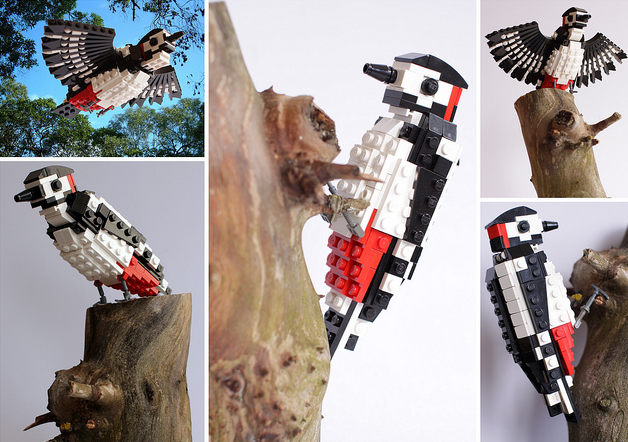
Colossal has a peek at some awesome birds made of LEGOs. These birds found in Britain include Puffin on a Cliff, Billy Blue Tit, Kingsley Kingfisher, Bobby Robin, Gloria Goldfinch, and Woody Woodpecker.
Via Colossal:I just stumbled onto this expertly crafted series of birds found in Britain by Thomas Poulsom. His use of color and perfect selection of bricks really bring these animals to life. You can see the entire series of six birds here, and apparently there are many more to come. (via lustik)
Update: Thomas mentions that if enough people vote for his designs, they might become actual sets.