

Nature has never needed our permission to be extraordinary. 🌲
But the way we arrive in it? That part we can get right. ⛺

There’s a version of camping that looks like a gear closet exploded in a meadow. Mismatched equipment, tangled cords, a tent that fights back.
And then there’s the other kind, where the smoke from your morning fire curls up into the pines, your coffee steams in a mug you actually love, and the light hits your campsite in a way that makes everything feel chosen, intentional. Earned.

This guide is for that second kind.
Whether you’ve never pitched a tent in your life or you’ve been camping for years and feel like something’s been missing from the experience, what follows is a considered introduction to sleeping under stars . One that doesn’t sacrifice beauty for function, or the planet for convenience. Because the outdoors deserve more than an afterthought, and so do you.
Start With the Philosophy, Not the Gear List
The best camping gear shares a quality with the best design: you stop noticing it. A well-made tent becomes part of the landscape. A good backpack disappears on your shoulders. The goal isn’t to bring more, it’s to bring better, and let the wilderness be the main event.
Buy once, buy well. Cheap gear breaks, gets replaced, and ends up in landfills. The brands worth spending money on — the ones in this guide — are built with longevity as a design constraint, not an afterthought. A jacket or lantern you’ll use for fifteen years is always the sustainable choice.
Leave No Trace. This isn’t a rule so much as a relationship: the land is letting you borrow it. Pack out everything you pack in. Camp on durable surfaces. Keep fire impact minimal. The most stylish thing you can do in nature is leave it the way you found it, or better.
Simplify deliberately. The wilderness has a way of clarifying what matters. Lean into that. You don’t need every gadget; you need the right ones.
Shelter: Where Architecture Meets Forest Floor

Your tent is your first design decision, and it shapes everything that follows — how the morning light feels, how you sleep, how much the experience costs you mentally when setup inevitably happens in the dark.
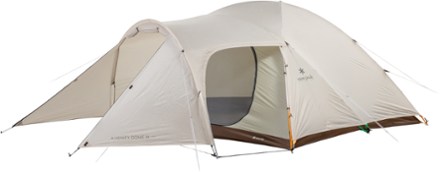
The Snow Peak Amenity Dome M Tent is to camping what Muji is to interiors: Japanese minimalism applied to function with an almost unsettling level of elegance. The Amenity Dome’s clean geometry and color-blocked panels look almost too beautiful to pitch in mud. Fortunately, it holds up to exactly that.
approx. $379
Shop the Snow Peak Amenity DomeFor the weight-conscious backpacker, the Big Agnes Tiger Wall UL2 offers a different kind of beauty: the kind that comes from radical reduction. Gossamer-light, architecturally confident, and built using fewer materials without sacrificing performance — the ultralight ethos is inherently sustainable, and this tent wears it with grace.

approx. $449
Shop the Big Agnes Tiger Wall UL2Sleep: Rest Well, Weigh Less

How well you sleep in the backcountry comes down to one often-overlooked variable: what’s between you and the ground. A great sleeping bag means nothing if you’re losing heat through a thin, uncomfortable pad — and the wrong pad ruins a trip faster than bad weather.
The Therm-a-Rest NeoAir XLite NXT is the benchmark. Ultralight, whisper-packable, and with an R-value of 4.5 that handles three-season conditions with ease, it’s the sleeping pad serious backpackers reach for. It packs into a stuff sack smaller than a water bottle and unfurls into something genuinely comfortable. This is the piece of gear that makes the difference between a night’s sleep and an actual night’s sleep.
approx. $220
Shop the NeoAir XLite NXTLight: Ambient, Not Artificial

The campfire does most of the heavy lifting in the light department, and that’s as it should be. But when you need something more — for reading, for finding things in your bag, for casting a warm glow across an evening — the lantern you choose matters more than you’d think.
The Barebones Living Forest Lantern has become something of an icon in design-forward camping circles, and for obvious reasons. Its lighthouse-inspired silhouette in hammered brass or matte red is the kind of thing you’d display on a shelf when not in use. It’s rechargeable via USB, which means no battery waste, and the warm amber LED light it throws is practically indistinguishable from candlelight.

approx. $64
Shop the Barebones Forest LanternCook: Because Camp Food Deserves Better

There is a direct correlation between the quality of your camp kitchen and the quality of your mornings. Coffee made in proper cookware, eggs in a pan that doesn’t stick — these are small dignities that compound over a weekend.
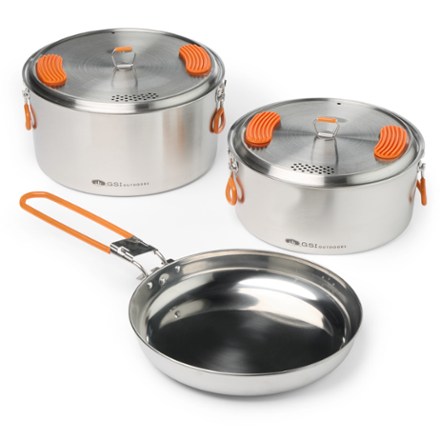
The GSI Outdoors Glacier Stainless Cookset is the workhorse here: nested, durable, stainless, and with none of the visual noise of most camp cookware. It will outlive most of the decisions you make in the next decade. Clean it with biodegradable soap, pack it into your bear canister, and let the ritual of cooking outdoors become one of the pleasures rather than the logistics.
approx. $119
Shop the GSI Glacier CooksetHydration: Drink Well, Travel Light

The single best thing you can do for the planet — and your pack — is to commit to a filtration system that makes single-use plastic bottles completely irrelevant. The LifeStraw Go Stainless Steel Water Filter Bottle threads this needle beautifully: the stainless body is clean and tactile, the integrated filter handles 99.9999% of bacteria and parasites, and every bottle sold funds a year of clean water access for a child in need.

approx. $44
Shop the LifeStraw Go BottleIf you prefer a bottle purely for storing and sipping, the Hydro Flask Wide-Mouth in one of its forest-adjacent colorways keeps water cold for 24 hours, coffee hot for 12, and comes with a lifetime warranty.

approx. $49
Shop the Hydro Flask Wide-MouthSit Down: The Art of the Camp Chair

Underrated in camping discourse: how you sit. A good camp chair is the difference between an evening that lingers and one you spend shifting weight and wishing you’d stayed home. The NEMO Stargaze Reclining Camp Chair is the result of taking that distinction seriously. Its suspension design — that gentle rocking lean when you settle into it — is the product of genuine ergonomic thinking. The frame is aircraft-grade aluminum and it packs down smaller than it has any right to.

approx. $199
Shop the NEMO StargazePack: Your Gear’s First Home

The bag you choose frames the entire experience. The Cotopaxi Allpa 28L is made entirely from recycled fabrics, available in a rotating palette of muted, earth-adjacent colorways, and designed with the kind of organizational clarity that makes packing feel like problem-solving rather than chaos. It’s also one of the few packs made by a brand that removes a pound of ocean waste for every product sold.
approx. $179
Shop the Cotopaxi AllpaLayer Well: The Right Jacket Changes Everything

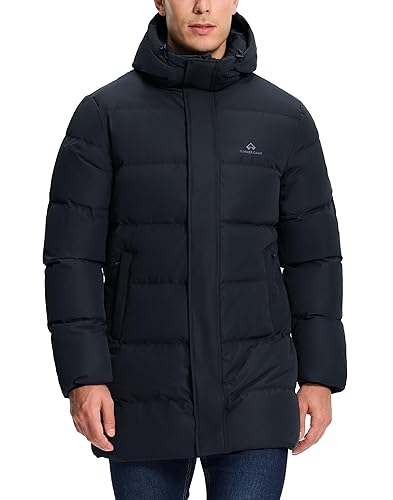
A good insulated jacket is the piece you’ll reach for at every trailhead, every cold morning, every unexpected summit. The The North Face THERMOBALL™ Eco 2.0 Jacket delivers serious warmth in an impossibly compact package. Filled with PrimaLoft® ThermoBall™ synthetic insulation — which mimics the warmth-trapping structure of down but keeps performing when wet — it packs into its own pocket to roughly the size of a water bottle. The silhouette is clean and slim, the colorways are understated, and it transitions effortlessly from trailhead to town.
It’s the jacket that disappears into your pack and reappears exactly when you need it — which, in the mountains, is always sooner than you expect.
approx. $199
Shop the North Face THERMOBALL™Wrap Up: The Rumpl Blanket
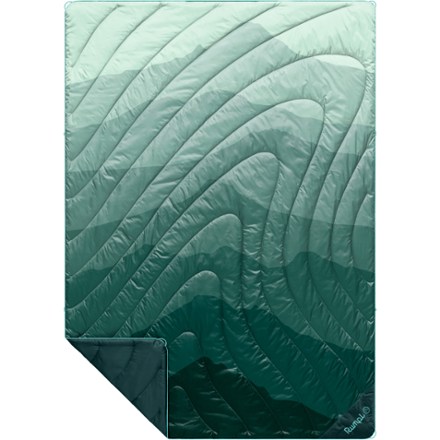
Mention the Rumpl Original Puffy Recycled Blanket at a campfire and someone nearby will ask where you got it. Made from post-consumer recycled polyester — between 16 and 100 plastic bottles depending on the size — and available in a staggering range of patterns and earth-tone colorways, it functions as insulation, as ground cover, as a lap blanket in the truck bed, and as the thing you throw over your knees when the fire dies down.
from $79
Shop the Rumpl Original Puffy BlanketThe Last Tool: A Notebook

This one might surprise you, but stick with it. A Moleskine Field Notes Journal — small enough to fit in a hip belt pocket, sturdy enough to survive the weather, is the object that turns a camping trip into something you’ll actually remember. Sketch the ridge line.
Write the coordinates of the spot you’ll come back to. The wilderness has a way of generating material; a good notebook is how you don’t lose it.

from $12
Shop the Moleskine Field Journal
The Bigger Picture
Camping, done well, is one of the most low-impact ways to spend your time. No flights, no hotel rooms, no carbon footprints measured in jet fuel. Just you, a patch of ground you’ve earned, and the particular silence that only exists far from roads.
But the gear we choose matters. Because manufacturing has impact, because quality displaces quantity, because the brands we support with our dollars shape what gets made next. The products in this guide were chosen because they sit at the intersection of things that are genuinely beautiful and genuinely responsible. Objects built to last, to perform, and to be worth carrying.
Need a place to go with your new gear? How about the least visited National Parks in the US!


1 Comment
It sounds like awesome equipment.