Tag

architecture

Browsing

Tags about architecture, buildings, and more.

The Sydney Opera House is already one of the most photographed buildings on earth, which makes it a bold choice as a projection surface. Every year during Vivid Sydney, artists use the Opera House’s curved shells as a canvas for large-scale light installations. The results range from subtle to completely overwhelming.

Screen Shot 2013-06-03 at 11.45.19 AM
Screen Shot 2013-06-03 at 11.35.44 AM The Sydney Opera House is one of the most famous buildings in the world, and right now, it’s being digitally skinned like a psychedelic chameleon. Part of the Vivid Sydney, artists are projecting amazing things on the sails of the building. Love it.025509-vivid-sydney Screen Shot 2013-06-03 at 11.34.35 AM Vivid_Sydney_2011 20091006205719_061009-vivid sydney Screen Shot 2013-06-03 at 11.33.26 AM vivid-sydney-lighting-the-sails-0001 579510_10151594503438397_683686045_n

The very gold, very ostentatious Grand Lisboa skyscraper in Macau is the home of a huge casino hotel. It also has a wild design that is unlike anything else we’ve seen in a tower before. With 47 floors and standing 856 feet high, the Grand Lisboa was built in 2007.

However, the most striking, surreal view of it is when seen from the ground level, juxtaposing the traditional houses and buildings against this huge golden behemoth.

Many online have described this as a scene out of Inception, where the buildings and landscape fold onto themselves.

Photo by Andy Luten


Going even further, this striking perspective by Paul Tsui is entitled “Invasion“, and almost looks like an alien spacecraft has landed on earth.

The photographer says no post-production was done, and this angle was taken with a specific telephoto lens.

Regardless of how you perceive the building and the feel it lends to Macau, it’s a reminder of how our built environment can vary so wildly, and give us such unique perspectives.

Photo via Pexels
Photo via Pexels
Photo via Pexels
Photo via Pexels
Photo via Pexels
Dimitar Karanikolov gives us a fascinating look at some of the most impactful Soviet-era sculptures and monuments from the past 40 years. The Brutalist-style sculptures feature vast amounts of concrete and metal.
Some of them are beautifully modern and unique, and painful to see them fully abandoned or forgotten.

See more of his beautiful photography on Instagram and Behance.

Images used with artist’s permission.Β 

Monument to the Fallen Soldiers – Kosmaj, Serbia.

“Flame” monumentΒ – Panicharevo, Bulgaria
Β BuiltΒ in 1975. Designed by Alexander Barov.

The Buzludzha monument is the crown jewel in Bulgariaβ€˜s socialist modernism. When I first entered the monumentβ€˜s grand hall as a child in the 1980s, it was still functional and in all its glory. I had never been in a more spectacular space, and the only thing I could compare it to were the Star Wars scenes I had just seen.

Exactly 30 years later, I walked into the building again, this time everything inside was falling apart and rain was pouring through the half-destroyed roof. It was like being in a movie again. Today, with the help of the Getty Foundation and numerous donors and volunteers, a reconstruction is underway.

The Casino in Constanta, Romania was built in 1910 and over the years has been used as a hospital, community centre and restaurant. Destroyed during the wars, rebuilt several times, neglected for decades, it is now being reconstructed. It is one of the most beautiful Art Nouveau buildings in the world.

Builders of the Bulgarian State” Complex in Shumen.

Abandoned socialistΒ monument, overhanging a mountain β€šfjordβ€˜Β full of floating houses. Vucha reservoir, Bulgaria

Pantheon, Mother Bulgariaβ€œ – Gurgulyat.
A 20 meters high truncated square pyramid made of pink concrete. Built 1985

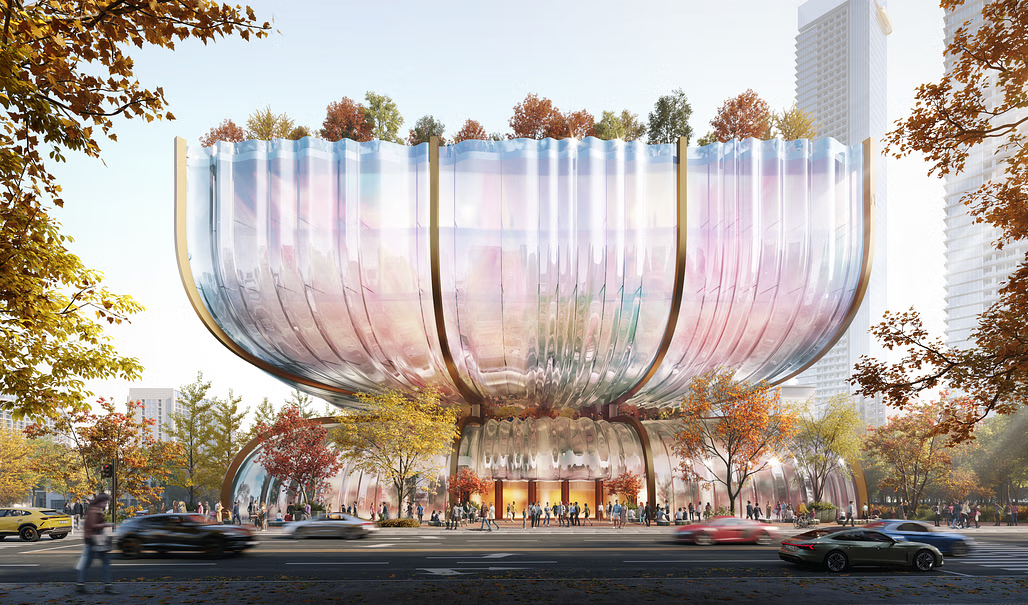
Heatherwick Studio has proposed a striking renovation of the famous Hanwha Galleria shopping space in Seoul. The design calls for two symmetrically opposed twin buildings, which have a dramatic hourglass shape, with a rippling glass texture.

Topped with trees and plants, and framed by copper beams, the spaces are sure to make a big impact on the South Korean capital. We especially like the glass form, and the way it resembles flowing water. It certainly creates a dynamic new design language that we’ve not seen before.

Via Metalocus:

β€œTraditionally, department stores are quite inward-facing, seeming closed off to the surrounding streets. But here we have a major intersection in Apgujeong with two buildings, east and west, which seemed like an opportunity to bring people together.

Combined with Hanwha’s ambition to bring more activity into the buildings, we wanted to provide a strong overall silhouette that would create a gateway, but also offer Seoulites new garden-like spaces to gather, shop and enjoy their city.”

Neil Hubbard, Partner and Group Leader at Heatherwick Studio.

The Latest Icehotel Features Dramatic Rooms Made Entirely of Ice and Snow

The original Icehotel has been crafting amazing guest rooms out of snow and ice ever since 1989.

Made from blocks of ice from the Torne River in Sweden, the designs of the Icehotel have gotten more and more ambitious and dramatic ever since, with true artisans crafting amazing suites in artistic reliefs, directly into the ice and snow.

The 2023-24 Icehotel is no exception, and we’ve featured a number of the suites below, ranging from a Beaver Lodge to Nebula’s Child, a dramatic room full of cracked snow and light.

Each of the 12 guestrooms was designed by a different set of artists or artisans, lending the entire hotel to more of a living art gallery than a hotel. You needn’t worry about getting cold on your stay, as thick mattresses, reindeer hides, and thermal sleeping bags make for cozy sleeping. A permanent warm lobby offers showers, sauna, and meals, making for a most luxurious and memorable experience.

As the spring comes and winter’s grasp begins the melt, the entire hotel melts and is recycled into the river once more.

Learn more and book your journey on Icehotel’s website.


The Latest Icehotel Features Dramatic Rooms Made Entirely of Ice and Snow
BEAVER LODGE, Dawn Detarando & Brian McArthur
deluxe art suite, ICEHOTEL 34. Photo by Asaf Kliger

The Latest Icehotel Features Dramatic Rooms Made Entirely of Ice and Snow

The Latest Icehotel Features Dramatic Rooms Made Entirely of Ice and Snow
DONΒ΄T GET UP, deluxe art suite by. Wilfred Stijger
& Edith van de Wetering, ICEHOTEL 34, photo by – Asaf Kliger
The Latest Icehotel Features Dramatic Rooms Made Entirely of Ice and Snow
Art Suite Cabinet in the Woods Design Hugh and Howard Miller
The Latest Icehotel Features Dramatic Rooms Made Entirely of Ice and Snow
Art Suite Tackara, Design by Javier Opazo
The Latest Icehotel Features Dramatic Rooms Made Entirely of Ice and Snow
Deluxe Suite Raindrop Prelude

The Latest Icehotel Features Dramatic Rooms Made Entirely of Ice and Snow


“Every year when the winter comes, the pristine waters the meandering of Torne River slow down and freeze into ice. On one chilly day in 1989, the first ever Icehotel was hand-sculpted out of these massive ice blocks harvested from this very river running alongside. Today, over three decades later, Icehotel has become a must-visit Swedish landmark for travelers from all parts of the globe.”


The Latest Icehotel Features Dramatic Rooms Made Entirely of Ice and Snow
KATT & RÅTTA deluxe art suite by Tjåsa Gusfors & Hanneke Supply. ICEHOTEL 34, photo by – Asaf Kliger–
NEBULAS’S CHILD , Deluxe art Suite by Edmund Chan & TaiTien Tan. ICEHOTEL 34, Photo by – Asaf Kliger
SEA INSIDE, deluxe art suite by Kristina Möckel
& Sebastian Scheller. ICEHOTEL 34, photo by – Asaf kliger
SLAVA,Ceremony Hall by Tomasz Czajkowski & Grzegorz
Olczak. ICEHOTEL 34, Photo by – Asaf Kliger

New developments in the field of architecture often garner a lot of attention, and recently that excitement has reached an all-time high as newly unveiled site plans show promise to revolutionize their respective projects.Β 

These new designs focus on creating an overall holistic approach to each project – one that seeks to merge both form and function in order to create something beautiful, sustainable, and long-lasting. We’ll take a look at how these new approaches can bring about innovative solutions for architects working today and why this is so important for development teams moving forward.

Introducing Site Plans – An Overview of What They Entail

Site plans are essential documents that showcase the spatial arrangement of a particular property. Whether you’re planning to build a house, warehouse, or outdoor recreational center, these plans are a fundamental aspect of any building project.Β 

This visual representation outlines details such as the boundaries, structures, parking areas, driveways, and other features that make up a specific piece of land. Moreover, according to the team at getasiteplan.com, in order to get a plan design for a site, you just need to have the address of the property for which you need the plan. That way, the designer can be able to get all the information needed from city or county records.


The Benefits of Incorporating a Holistic Approach to Site Design

Designing a website can be a daunting task, but incorporating a holistic approach can have numerous benefits. Considering not only the visual design, but also factors such as user experience, accessibility, and search engine optimization can help a site become more well-rounded and effective.Β 

A holistic approach also takes into account the functionality and purpose of the site, creating a cohesive and intentional design that can better engage and retain visitors. Additionally, implementing a sustainable design philosophy can have environmental benefits, such as reducing the energy consumption of the site. Overall, incorporating a holistic approach to site design can result in a more successful and impactful website.


Exploring Different Strategies for Crafting an Effective Site Plan

Crafting an effective site plan is crucial to ensure that the design and flow of a project are well-executed. To achieve this, there are various strategies you can use. One approach is to focus heavily on the aesthetics of the design, ensuring that every detail is visually appealing while still practical.Β 

Another strategy is to prioritize functionality, making sure that the site plan meets all necessary requirements, is easily navigable, and caters to the needs of the users. Additionally, it’s essential to consider the terrain and environs, ensuring that the plan complements the natural landscape while still maintaining a cohesive design. Exploring different strategies can help you craft a site plan that is both visually stunning and functional, ensuring that your project’s execution is a success.


Examining the Role of Sustainable Architecture in Creating Desirable Sites

Sustainable architecture is more than just a trend. it is a necessary component in creating attractive and highly desirable sites.Β 

Using eco-friendly materials and designing buildings with energy efficiency in mind not only helps to reduce the carbon footprint of a structure, but it also helps to lower overall costs in the long run. Many of the world’s greatest architects have taken environmental concerns to heart, and are able to achieve elegance and functionality while also maintaining a keen focus on planet-friendly design.Β 


Harnessing Technology to Make Site Plans More Efficient and Cost-Effective

As the construction industry becomes increasingly reliant on technology, it’s only natural that site plans would follow suit. By harnessing the latest technological advancements, architects and contractors can streamline the site planning process, reducing costs and improving efficiency.Β 

From 3D mapping to software that automates certain aspects of the planning process, the latest tools and techniques are revolutionizing the way site plans are created. With the ability to view and manipulate plans in real-time, stakeholders can identify potential issues and make changes on the fly. The end result is a faster, more cost-effective planning process that enables construction firms to deliver projects on time and on budget.


As evidenced by the topics discussed, site planning is a complex and multilayered process. It requires skillful coordination between multiple stakeholders, often from various disciplines. Yet with diligent research, open dialogue, and a clear objective for the project, you can transform any given environment into an exemplary expression of all that your creative vision has to offer.Β 

When it comes to creating a functional and aesthetically pleasing environment that meets both budget and sustainability requirements, making use of advanced technology in combination with innovative techniques can be highly beneficial. So take advantage of the many resources available and get started on your very own site plan today!

Though still in concept form, this home is a fascinating study in design, relying on algorithms to create a one piece flowing roof that resembles a toadstool or a complex seashell.

It’s a beautifully complex design, one that took months of study and engineering to plan. Hong Kong-based LEAD design is known for exploratory architecture, and have shared a video of the home’s planned engineering.

Nestled in the mountains of Hokkaido, Japan, the home should be an engineering marvel when it is completed. We’ll revisit when we hear about the completion of the YEZO Retreat.

See more on LEAD’s website.

With a remarkable swooping roof, and the views of spectacular mountains below, this home design feels like something out of fantasy movies.Β 

Shipping containers have long been recognized for their versatility beyond mere cargo transport. Over the years, they’ve been ingeniously repurposed into everything from pop-up shops to entire homes, showcasing the limitless possibilities of used shipping containers. These robust structures, often forgotten after their shipping days are over, find new life in innovative architectural projects.

By integrating reclaimed shipping containers into designs, architects and designers not only embrace sustainability but also create unique, durable, and cost-effective spaces. One such remarkable project can be found in Hocking Hills, Ohio, where a stunning home has been crafted from a stacked group of these containers, offering a fresh perspective on modern living.

On the tough metal shell of the container, people can also give full play to their creativity and add some personalized decorations. Among them, custom neon signs are a good choice. 

The color and pattern of neon signs can be customized according to the style of the house and the owner’s preferences, either warm and romantic or fashionable and avant-garde. Even some personalized text can be customized for commercial use or instructions. These custom neon signs are not only lighting tools, but also decorative art that adds the finishing touch. Through the interweaving of light and shadow, the container house achieves a perfect balance between practicality and beauty, showing a unique living aesthetic.

Created from a stacked group of shipping containers, the home has a great angle of approach, and offers impressive views out of its main window. We appreciate the way the deck flows naturally around the property, making the home feel rooted and more practical. Called the Box Hop, you can follow the journey of it being built and now rented out on Instagram.

Gathered from a 1959 roofing company calendar, this collection of lovingly illustrated ranch homes show the style in all of its Americana glory.

Originating in California, the ranch style home fused ‘wide open living’ with modernism, creating a casual style that is still heavily felt in architecture throughout North America and other parts of the world.

We appreciate the variety of styles shown in the series. Via Design You Trust:

This elegant and extensive treetop walkway was recently completed in Norway, with the purpose of allowing accessibility to nature for all that seek it, even those in wheelchairs, push chairs, and those with disabilities. Created by Architecture studio EFFEKT, the walkway is a gracefully curving wooden build, with a slow incline to over 15 meters in the air, overlooking the beautiful Hamaren Activity Park in Fyresdal.

The idea of an elevated walkway is nothing new, nor is one that snakes its way through the forest. But the intention from the designers was to create something that felt approachable to all, not just those in perfect physical ability. With the right height, slope, and onramps, the walkway may allow those who aren’t often able to venture into nature a rare opportunity to disconnect and enjoy.

Made from native pine wood, the treetop walkway winds through the scenery for 1 kilometer, and is a welcomed addition to the larger Hamaren Activity Park, which opened in Fyresdal in 2017. We hope this type of accessible design can inspire other projects that feel inclusive and welcoming. Via Dezeen:

Imagine an entire valley filled with a ghost town Disneyland, minus the fun. That’s basically what you see below, and boy, oh boy, it’s bizarre.

Burj Al Babas is the name of the development, which has 587 homes, in the style of miniature castles, complete with gothic roofs and stone detailing. It’s set in the spa town of Mudurnu in Turkey.

The twist is, this village is entirely empty. Β Started in 2014, this huge development was the work of the Sarot Group, an ambitious developer keen to create a destination for those wanting a mediterranean climate and a cookie-cutter castle home. Β 

As the development neared completion, the company responsible declared bankruptcy, due in part to numerous complaints about its business, environmental, and aesthetic practices. Investors pulled their money, and then in 2020, the pandemic put a permanent halt to the construction, leaving the entire project to sit, empty and abandoned.Β 

In proper ghost town fashion, the streets are eerily silent, the houses sit entirely empty, most of them unfinished inside.

With millions of dollars of debt, it’s unlikely the project will restart, and even if it did, would people want to live in this strange, eery castle-land?

Surely a tragic waste of materials, manpower and money, Burj Al BabasΒ sits as a testament to bad planning, and bad timing.

Via Architectural Digest:

The mini castles sit idly, unfinished inside, and identical.

In a dusting of snow, there is a bit of charm to these castles. Yet the size and proximity feels wrong.

Will this huge development ever continue, or sit to rot?

For more on weird, beautiful, and fascinating architecture, check out the Moss and Fog page on Architecture.

One of the premiere natural history museums in the world is in New York City, and has wowed children and adults alike for over 150 years.

Opened in 1869, the museum is home to some of the world’s most complete dinosaur skeletons, room after room of dioramas, and over 34 million specimens of fossils, animals, plants, rocks, meteorites and more.

Now the museum is getting ready to open its biggest expansion in over a century, with the 230,000 square foot Gilder Center.

A striking new expansion, the Gilder Center is decidedly organic and modern in appearance, juxtaposing the classical architecture of the existing museum. Architect Jeanne GangΒ is responsible for the undulating, organic design, which invites visitors to explore not just the exhibits but the building itself.

The building’s undulating forms are made using sprayed concrete, giving it a cave-like, organic appearance.

Construction workers building the Gilder Center at the American Museum of Natural History.

The exterior of the new expansion, showing the organic forms.

The museum’s expansion is nearing completion, with an estimated February 2023 open date.

Part of the expansion includes high-tech permanent installations like “Invisible Worlds”.

Renderings of the interior, with finished appearance of the fluid forms.

Exterior renderings showing the completed expansion.

The completion of the Gilder Center will be a big milestone for the American Museum of Natural History, which welcomes over 4 million visitors a year. See more detail about the construction on Dezeen.

Skyscrapers by definition reach into the sky, with the highest of them reaching well over 1,000 feet into the air.

What would a 105 mile-long building be called, if it ran along the ground in a sleek linear fashion?

That’s the audacious design behind The Line, a proposed mega-city concept in northwest Saudi Arabia. Β The mirrored exterior of the linear city will be 500 meters tall, which in itself will be an extremely tall structure, with the inhabitable area of the city within.

Homes, shops, hospitals, and leisure zones would all be built and stacked within The Line’s 200 meter-wide footprint. The entire city would be car-free, creating an entirely different type of living environment.

The megastructure plans to have a transportation system that can speed from one end to the other in under 20 minutes. This is to create a sense of mobility, without the hassle or space requirements of individual cars.

In the renderings, we see futuristic glass designs within The Line’s frame, we see Blade Runner-esque living quarters, digital projections, and even dramatic water features that would create an oasis feeling within the desert.

Part of the Neom development project near the Red Sea, The Line is the most daring and far-reaching concept that would redefine not just desert living, but how cities could be built.

The idea of building a megacity from scratch is lofty on its own, but creating one of this magnitude and radical design should be taken with a grain of Arabian sand. Regardless, it’s fun to see the renderings, and helps to push the vision for architects into the 21st century.

Designs by US-based firm Morphosis. Read more on Dezeen:

“At The Line’s launch last year, we committed to a civilizational revolution that puts humans first based on a radical change in urban planning,” said Saudi Arabia’s crown prince Mohammed bin Salman.

“The designs revealed today for the city’s vertically layered communities will challenge the traditional flat, horizontal cities and create a model for nature preservation and enhanced human livability,” he continued.

“The Line will tackle the challenges facing humanity in urban life today and will shine a light on alternative ways to live.”

This super sleek and futurist home in Bel-Air stands apart from the stately mansions and celebrity gated communities. Looking like a cross section of a Star Trek ship, the home features lines that are supposedly automotive inspired, and created using CNC machine milling.

The 7,440 square foot home would seem enormous in most places, but fits its corner lot surprisingly well, featuring three elaborate levels, dramatic interior features, and luxury finishes.

A 16-foot cantilevered second floor, movie theater, swimming pool and more make it just about as posh as can be expected from its $16,500,000 list price.

If you end up purchasing the home, we kindly request an invite. See more on Compass Realty.

The last decade have seen a number of advances in timber architecture, with methods like cross-laminated timber becoming popular, eco-friendly alternatives to traditional construction.

This method of construction has been reserved for smaller-scale buildings, but the envelope is being pushed, further into the sky.

A new 300-meter tower is set to rise in Winterthur, outside of Zurich. Constructed of load bearing timber, the building will be the world’s tallest using wood as the primary structural material.

The mass timber structural core and load-bearing system will be built by construction company Implenia, with design by architecture firm Schmidt Hammer Lassen.

The building will be clad in brick, giving it a distinct and stately appearance, though the core and supportive structures will be made of mass timber.

Via Dezeen:

“Mass timber is increasingly being used to create tall buildings. In 2019, CF MΓΈller Architects completed Sweden’s tallest timber building, the Kajstaden Tall Timber Building, an 8.5-storey-tall apartment building built entirely from cross-laminated timber.

Danish architecture studio 3XN recently proposed a pair of two cross-laminated timber office buildings for Toronto which according to the studio, would become North America’s tallest timber office building.”

A look at mass timber construction, which includes beams and forms made from tightly bonded wood.

The world has been won over by the strength, courage, and fierce resistance of the Ukrainian people.

We wanted to further celebrate not just Ukrainian strength, but some of their creative achievements as well.

YOD Group is an interior design company based in Kyiv, creating impressive one-of-a-kind interiors for high end restaurants, bars, and event spaces around the world.

Below are some of their projects, showing beautifully lit, dramatic spaces, and world class design. Β See more on their website.